Baby Snake With a Red Stripe on Back
This post is meant as an aid to snake identification. In addition to posting photos of all the snakes, I try to point out color variations within a species, where the species is found in Ohio, and what the typical length of an adult is. I have tried to group snakes to make it easier to distinguish between similar-looking species.
I focus on the visual characteristics of the snakes; for a more detailed description of the snake (its habitats, behavior, etc.), I have provided links to three sources for each species:
- ODNR: Ohio Department of Natural Resources
- OPLIN: Ohio Public Library Information Network (includes a map for each species showing its range within Ohio)
- Wikipedia (sometimes there is not specific information on the subspecies identified here, and instead there's a link to the more general species).
Venomous Snakes
Family Viperidae
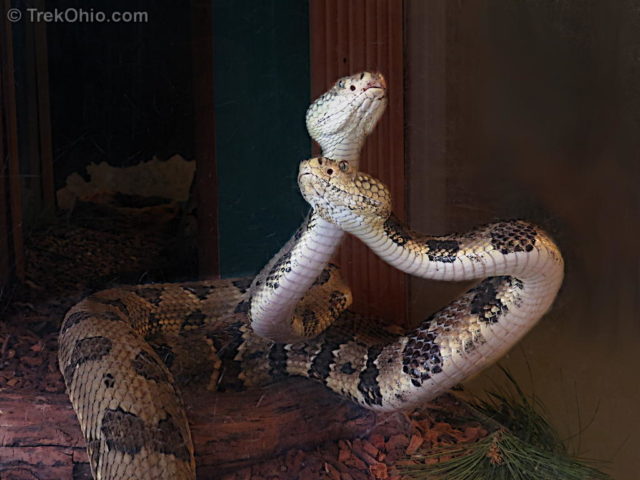
Two Timber Rattlesnakes (Crotalus horridus)
Length: 36-54 inches
Color: yellow to brown background with dark brown or black bands across the back.
Location in Ohio: far south of state; before 1960 it was also seen on islands in western Lake Erie and on the Catawba and Marblehead Peninsulas.
Ohio Division of Wildlife video: Timber Rattlesnake: Scioto County, August 18, 2012
ODNR | OPLIN | Wikipedia
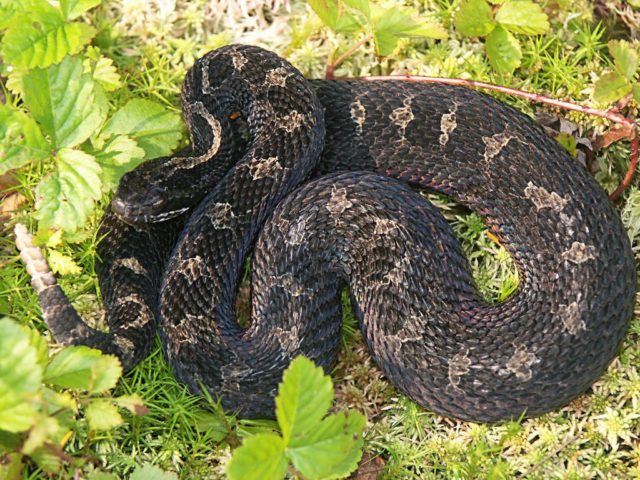
Eastern Massasauga Rattlesnake (Sistrurus c. catenatus)
Length: 20-30 inches
Color: background is gray or brownish-gray with darker splotches;
Black bands running from eye to corner of mouth; another band goes over the head
Location in Ohio: glaciated parts of western and northern Ohio.
ODNR | OPLIN | Wikipedia
The above rattlesnake species above are the only ones with a true rattle. However many species of snake will vibrate their tail when they feel threatened. If they are in dry leaf litter, this may sound like a rattle.
Pictured below is the Northern Copperhead. Sometimes the Eastern Foxsnake is mistakenly believed to be a copperhead because some individuals have a copper-colored head.
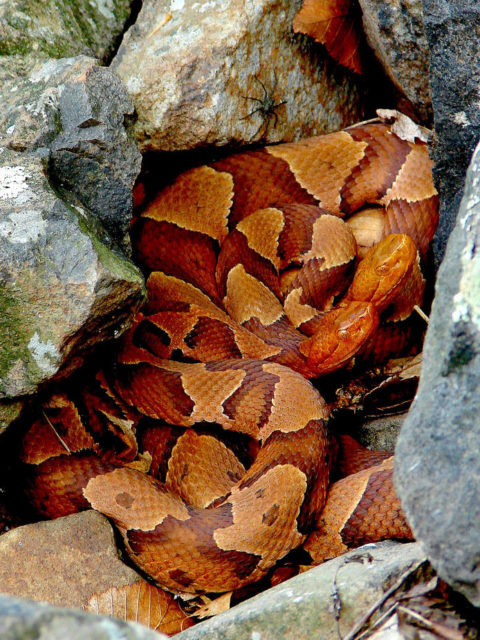
Two Northern Copperheads (Agkistrodon contortrix mokasen)
Length: 24-36 inches
Location in Ohio: eastern half of state (excluding far north) plus the southwest corner of state
ODNR | OPLIN | Wikipedia
The venomous water moccasin or cottonmouth does not occur in Ohio.
Pretends to be Venomous, but it's not
Family Colubridae
I am singling out the Eastern Hog-nosed snake here because it does such a convincing job of behaving like a venomous snake. When alarmed it flattens its neck, puffs out its body, coils and strikes aggressively at the perceived threat. Some people who feel threatened by this play-acting end up killing the snake, so in those case the strategy sadly backfires.
As a second line of defense, the Eastern Hog-nosed snake will play dead by flipping over on its back with its tongue hanging limply from its open mouth. To make its act as convincing as possible, it even tries to smell like a corpse. It releases a foul-smelling musk and may have a bowel movement. The Tennessee Wildlife Resources Agency has a nice photo of the snake playing dead here.
The upturned nose that gives the snake its name is used to dig up its prey, usually toads.
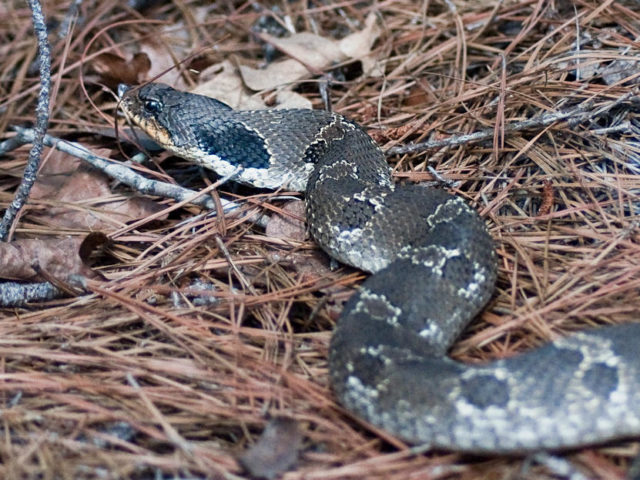
Eastern Hog-nosed Snake (Heterodon platirhinos)
Length: 18-30 inches
Color: gray background with black splotches, or yellowish-brown background with darker brown splotches (see below).
Location in Ohio: the south, the central region, and the northwest.
ODNR | OPLIN | Wikipedia
In the above photo, note the upturned nose which gives the snake its name.
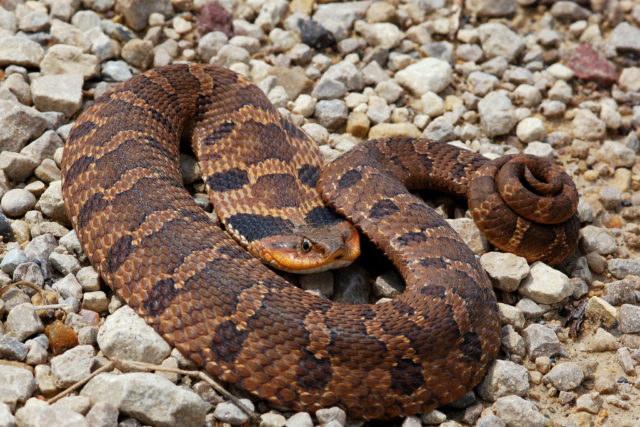
Eastern Hog-nosed Snake (Heterodon platirhinos) — Eastern Hog-nosed Snake flattening its neck to create a cobra-like hood.
Nonvenomous Snakes
Family Colubridae
Aquatic Snakes
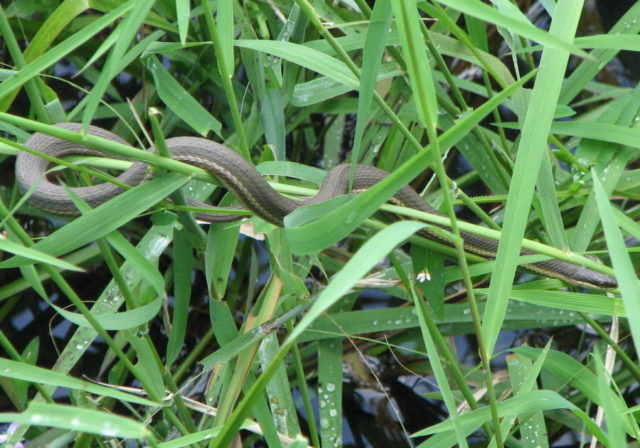
Queensnake (Regina septemvittata)
Length: 15-24 inches
Color: olive-brown, chocolate-brown or black with a yellow stripe running low along its sides
Location in Ohio: Widely distributed
ODNR | OPLIN | Wikipedia
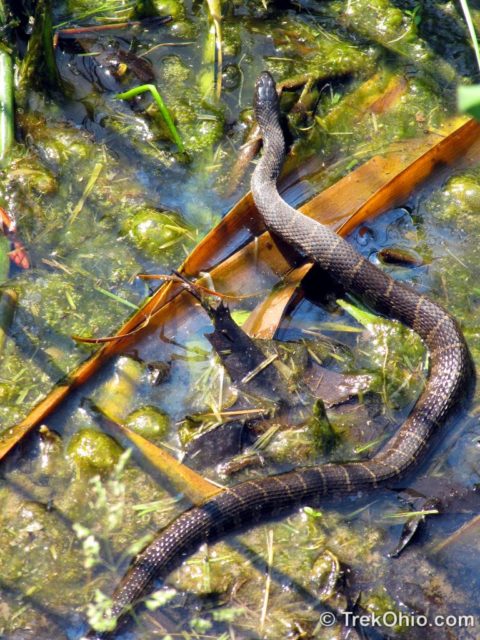
Common Watersnake (Nerodia sipedon sipedon)
Length: 24-42 inches
Color: the back may be reddish-brown, brown, gray or black with bands or blotches across it; becomes darker as it ages; the belly is white, yellow, or gray with spots.
Location in Ohio: Widely distributed
ODNR | OPLIN | Wikipedia
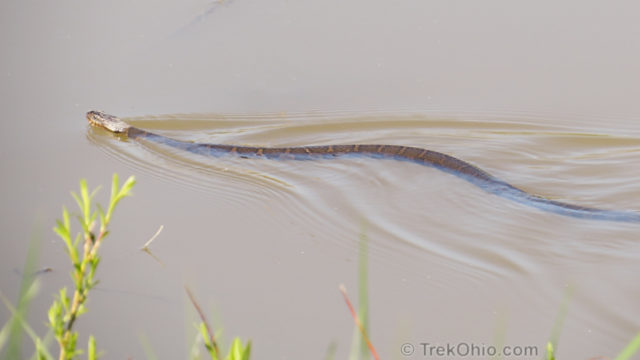
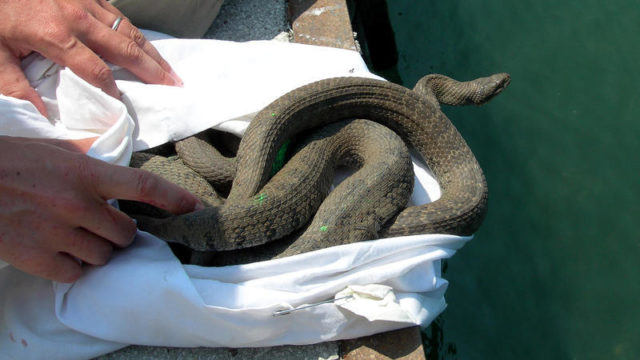
Lake Erie Watersnake (Nerodia sipedon insularum)
Length: 24-42 inchesColor of back: grayish, greenish, brownish;
Color of belly: white or pale yellow, occasionally with pinkish tinge down the middle
Location in Ohio: Islands of Lake Erie
ODNR | OPLIN | Wikipedia
Another aquatic watersnake that I've grouped with Snakes having Reddish Bellies is the Copper-bellied Watersnake seen below.
Snakes with Reddish Bellies
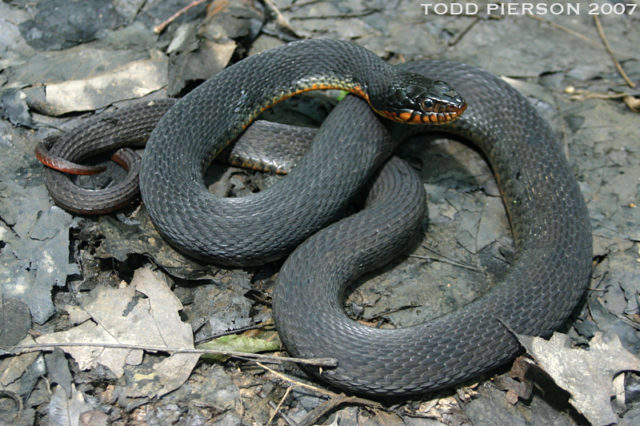
Copper-bellied Watersnake (Nerodia erythrogaster neglecta)
Length: 24-42 inches
Color: back is black or brownish black; belly is orange-red or red
Location in Ohio: Williams County; possibly scattered remnants elsewhere
ODNR | OPLIN | Wikipedia
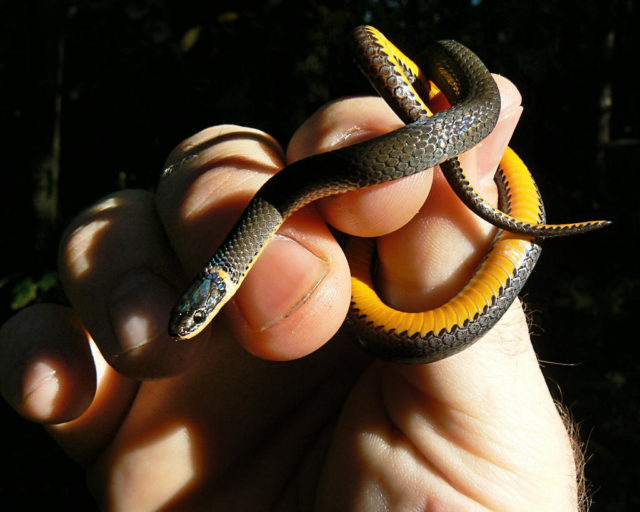
Northern Ring-necked Snake (Diadophis punctatus edwardsii)
Length: 10-15 inches
Color: background is olive, brown, gray or black; the neck ring is yellow, orange, cream or white.
Location in Ohio: southern, eastern, and central Ohio, plus the border around Lake Erie
ODNR | OPLIN | Wikipedia
The Northern Red-bellied snake (pictured immediately below) has three, light-colored scales at the base of the head, while Kirkland's snake (its picture follows the Northern Red-bellied snake) does not have this light-colored blob to the rear of its head. Another difference is that the Kirkland's snake has black spots running down each side of its belly, but the belly of the Northern Red-bellied snake is a uniform red.
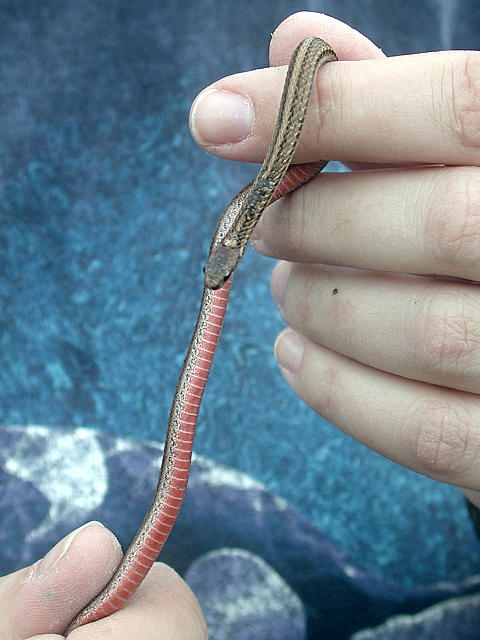
Northern Red-bellied Snake
(Storeria occipitomaculata occipitomculata)
Length: 8-10 inches (20-25 cm)
Color: background color is gray, or gray-brown with four stripes running down the back that are slightly darker
Location in Ohio: located in a diagonal band going from south-central Ohio through central Ohio to northeast Ohio; also found in a small pocket in northwest Ohio.
ODNR | OPLIN | Wikipedia
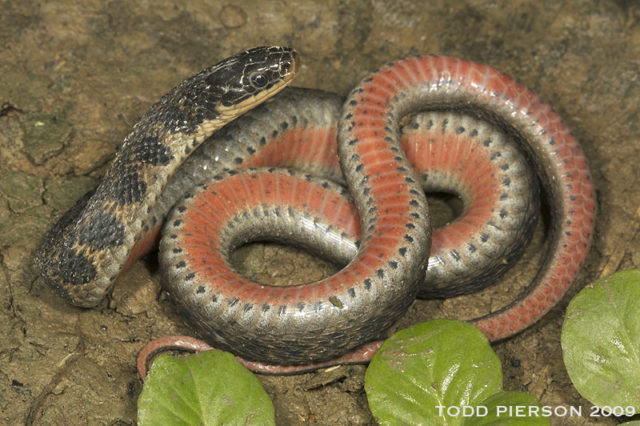
Kirtland's snake (Clonophis kirtlandii)
Length: 14 – 18 inches
Color: The back is brown or gray with large, dark spots on each side; the belly is reddish with smaller dark spots running down each side.
Location in Ohio: most of Ohio except for the far east and far south; most common in Lucas and Hamilton counties
ODNR | OPLIN | Wikipedia
Both of the wormsnakes below have pink bellies; the color may vary from light pink to coral pink. The belly scales tend to be somewhat translucent so it may be possible to make out some of the snake's internal organs while looking at its belly. The top is brown or pinkish-brown, with younger snakes being a darker brown than older snakes.
The head is very small and pointed with tiny eyes. The tail of both species tapers to a sharp point. Some people think this is a stinger, but it is not. It is believed that the pointed tail may be used in digging into the earth.
The only real difference between the Eastern and Midwestern wormsnakes has to do with the scales on the top of the head from the eyes to the snout. These scales are fused for the Midwestern wormsnake, while they remain separate for the Eastern wormsnake.
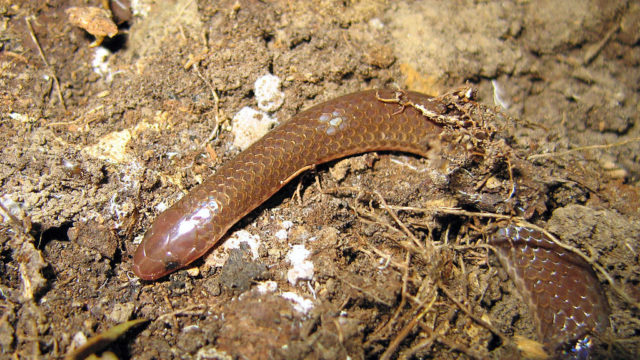
Eastern Wormsnake (Carphophis amoenus amoenus)
Length: 7.5-11 inches
Color of back: pinkish-brown, brown, dark brown; Color of belly: light pink to coral pink
Location in Ohio: southeast and south-central Ohio.
ODNR | OPLIN | Wikipedia
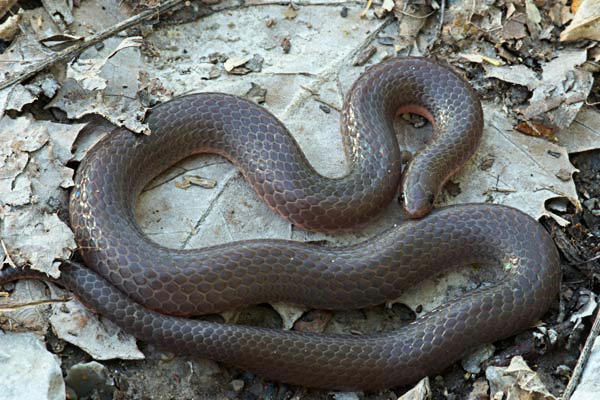
Midwestern Wormsnake (Carphophis amoenus helenae)
Length: 7.5 – 11 inches
Color of back: pinkish-brown, brown, dark brown; Color of belly: light pink to coral pink
Location in Ohio: southern third of the state.
ODNR | OPLIN | Wikipedia
Brown snakes
Both the Northern and Midland Brownsnakes have two dark lines running down their backs. However the Midland Brownsnake also has some dark lines crossing over its back creating a ladder-like look. The two species do interbreed producing what are called intergrade offspring with characteristics of both parents.
The distribution of the population in Ohio has something of a "T" shape; it is found in most of northern Ohio, and in a band that runs from north to south through the center of Ohio.
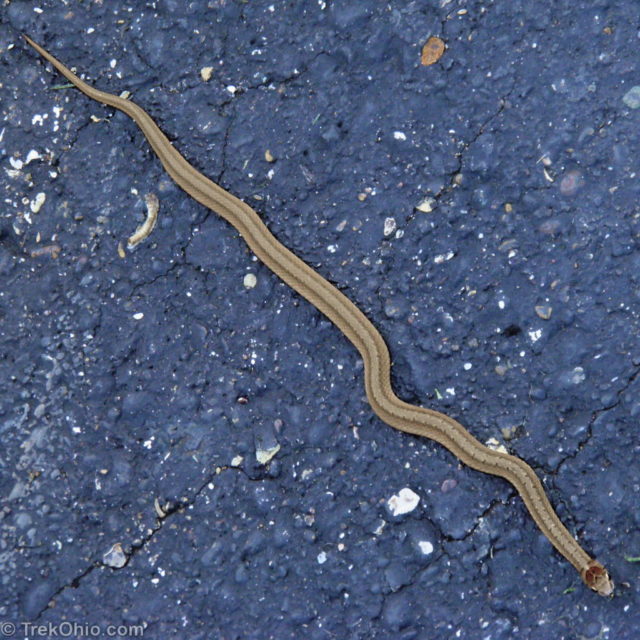
Northern Brownsnake (Storeria dekayi dekayi)
Length: 9 – 13 inches
Color of back: brown with two parallel lines of dark spots running down its back; Color of head: Dark brown on top, with thin, brown marks on the sides of the head
ODNR | OPLIN |Wikipedia
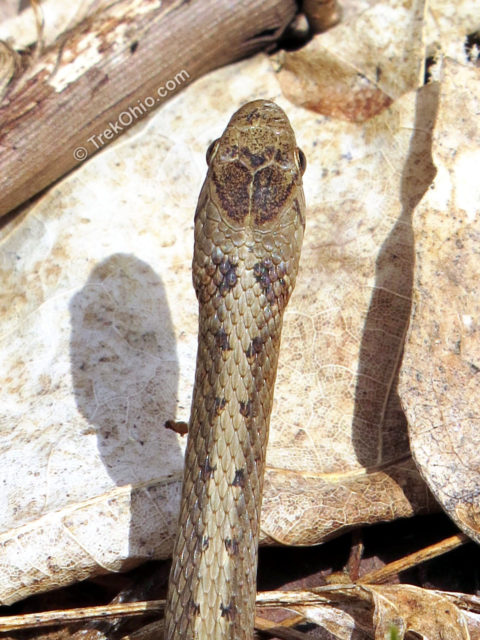
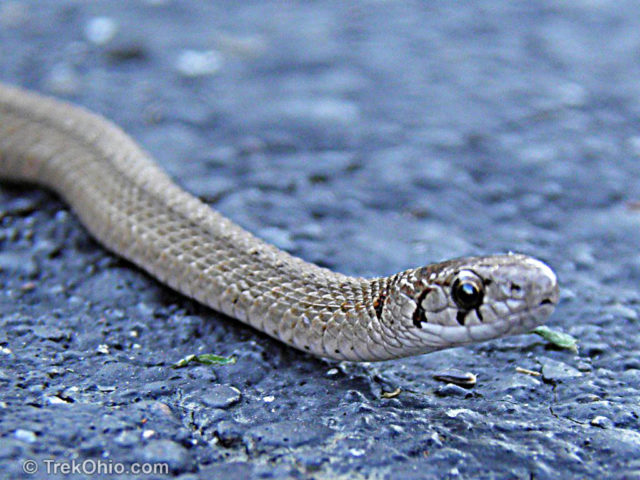
Both the Northern and Midland Brownsnake head have dark brown marks on the side of their heads.
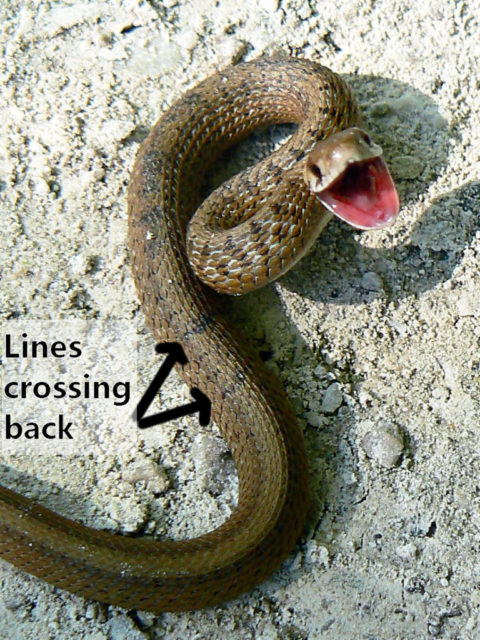
Midland Brownsnake (Storeria dekayi wrightorum)
Length: 9 – 13 inches
Color: Black lines cross its back; otherwise the coloration is like the Northern Brownsnake.
Location in Ohio: most of the state except unglaciated southeast
ODNR | OPLIN |Wikipedia
Unlike the brownsnakes above, the Eastern Smooth earthsnake below does not have any distinct markings on its back and it has a stouter body.
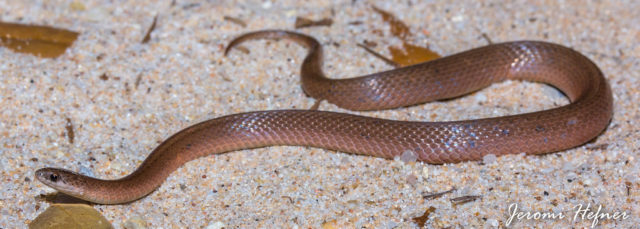
Eastern Smooth Earthsnake (Virginia valeriae valeriae)
Length: 7-10 inches
Color of back: gray or reddish to yellowish brown, sometimes with a faint stripe going down the middle of its back. Color of belly: white or yellowish
Location in Ohio: central portion of the south, especially Shawnee and Pike State Forests.
ODNR | OPLIN | Wikipedia
Gartersnakes & Ribbonsnakes
The following are a few differences between individual species that have helped me to make an identification.
- Unlike the Eastern Garter snake, the Plains garter snake has two, light-colored spots on the top, rear part of its head; they're called parietal spots.
- Unlike Garter snakes, the Eastern ribbonsnake has a thin, white vertical mark in front of each eye. If interested you can check out this close-up photo of an Eastern ribbonsnake's head where the white mark is plainly visible.
- To distinguish between an Eastern Garter snake and a Butler's Garter snake, note where the lateral (side) stripe is relative to the snake's ventral (belly) scales. The lateral stripe is found on the second and third scales of the Eastern Garter snake. However this stripe is centered on the third scale of the Butler's Garter snake, with the coloration extending up halfway on the fourth scale and down halfway on the second scale. The photo below shows how to count scales on a snake.
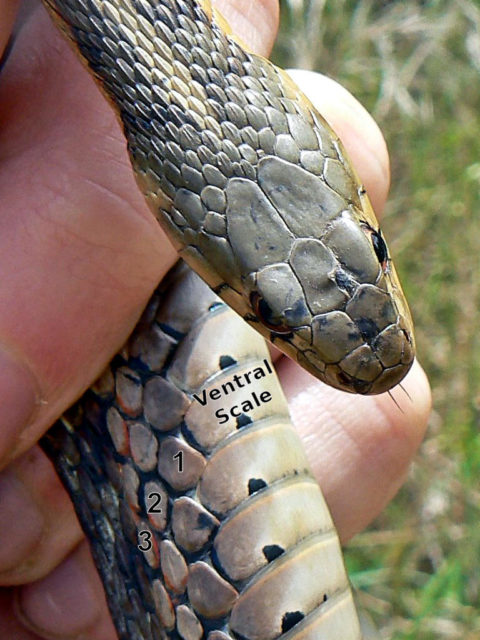
Eastern Garter Snake (Thamnophis sirtalis)
The lateral stripe on an Eastern Garter snake is present on the second and third scales when counting the scales diagonally starting with the first scale next to the ventral scale.
The scales above this snake's head also illustrate what is meant by keeled scales. Scales are said to be keeled if they have a ridge running down the middle.
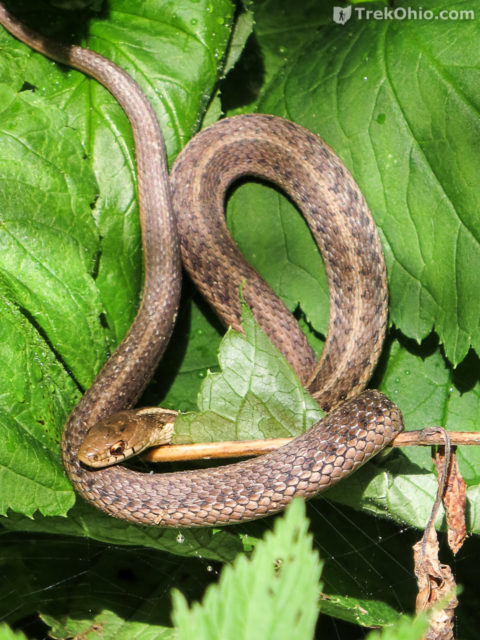
Eastern Garter Snake (Thamnophis sirtalis)
Length: 18-26 inches
Color: background may be black, brown, green, or olive. The stripes may be yellow, or orange.
Location in Ohio: Widely distributed throughout the state
ODNR | OPLIN | Wikipedia
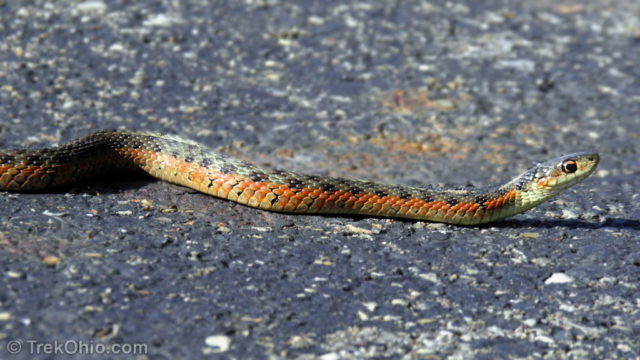
This one has an orange stripe.
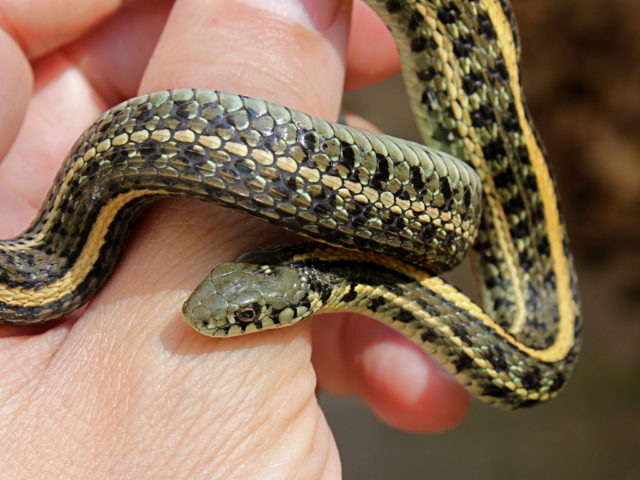
Plains Gartersnake (Thamnophis radix)
Length: 20-28 inches
Color: background is brown, green, or reddish with yellow or orange stripes
Location in Ohio: Wyandot and Marion Counties
ODNR | OPLIN | Wikipedia
Photo courtesy of Alkatar, license: Public Domain
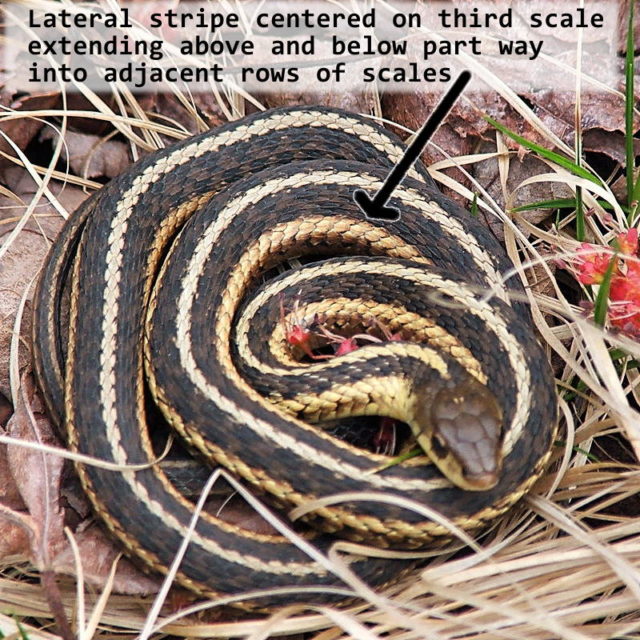
Butler's Gartersnake (Thamnophis butleri)
Length: 15-20 inches
Color: background is olive-brown to black with yellow to orange side stripes.
Location in Ohio: northwestern quadrant of Ohio
ODNR | OPLIN | Wikipedia
Photo courtesy of Andy Avram who retains all rights; included here with his permission

Short-headed Garter Snake (Thamnophis brachystoma)
Length: 18-26 inches
Color: Background color is olive to olive-brown. Lateral (side) stripe is yellow or light beige. Like the Eastern Garter Snake, the Short-headed Garter Snake has lateral stripes on the second and third scales. Unlike the Eastern Garter Snake, there are no black spots between the stripes of the Short-headed Garter Snake. Unlike the Ribbonsnake, there is no white line in front of the eye of the Short-headed Garter Snake.
Location in Ohio: Found in two to three eastern counties in the state.
PA Herps provides more information on this snake, including a photo gallery..
This photo from Wikimedia Commons is in the Public Domain

Common or Eastern Ribbonsnake (Thamnophis sauritus sauritus)
Length: 18-26 inches
Location in Ohio: northern and east-central Ohio.
ODNR | OPLIN | Wikipedia
Green snakes
The Rough Greensnake has keeled scales, while the Smooth Greensnake does not. I don't have a close up photo of the scales of the Rough Greensnake, but I can give you an idea of what I mean by keeled scales. There is a close up view of the keeled scales of the Eastern Gartersnake earlier in this post (it's the same photo that labeled some of the snake's scales as ventral scale, 1, 2, 3). If you look at the scales above the garter snake's head, you'll see little ridges going down the middle of each scale. These ridges are said to be the scale's keel.
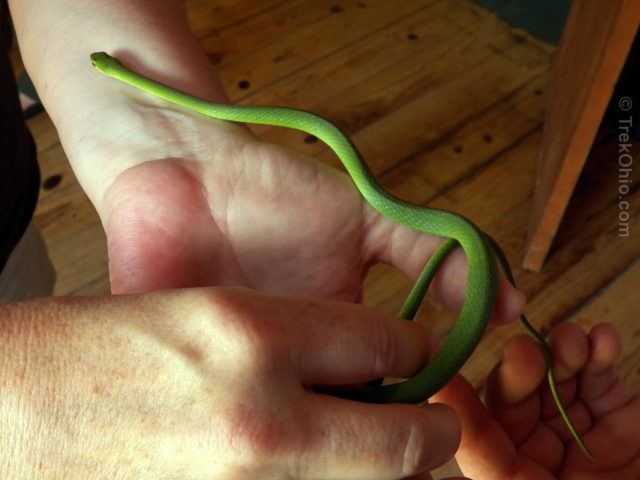
Rough Greensnake (Opheodrys aestivus)
Length: 22-32 inches
Location in Ohio: extreme southern counties
ODNR | OPLIN |Wikipedia
Black and Blue Snakes
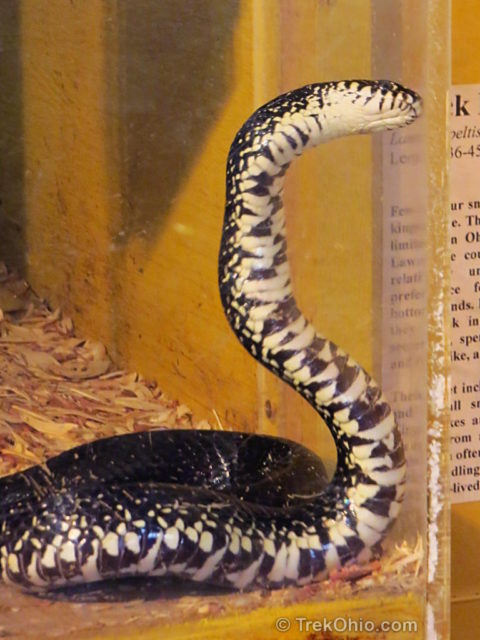
Eastern Black Kingsnake (Lampropeltis getula nigra)
Length: 36-45 inches
Color: the back may be solid black, or it may have a faint chain-like pattern; the belly is a checkered black and white.
Location in Ohio: central portion of the extreme south of the state
ODNR | OPLIN | Wikipedia
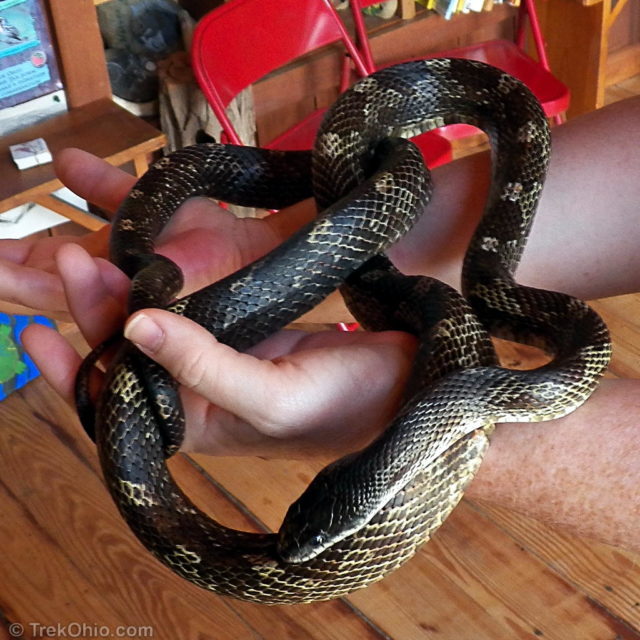
Eastern Ratsnake (Pantherophis alleghaniensis)
Length: 47-72 inches (largest snake in Ohio)
Color: juvenile is gray with splotches, but the snake gets darker as it matures
Location in Ohio: Widely distributed
OPLIN | Wikipedia
UPDATE: Formerly ODNR listed the Eastern Ratsnake as the largest snake in Ohio; now it has re-classified this snake in its species index as the Gray Ratsnake (Pantherophis spiloides).
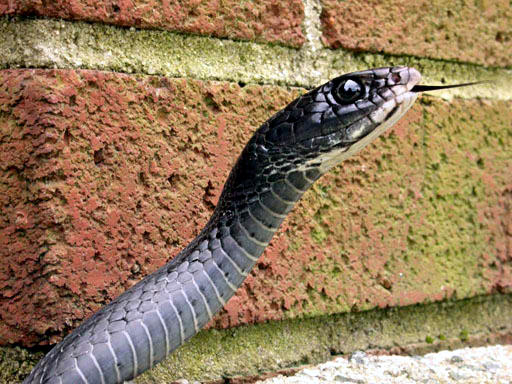
Northern Black Racer (Coluber constrictor constrictor)
Length: 36-60 inches
Color: black with white chin and throat
Location in Ohio: east and southeast
ODNR | OPLIN | Wikipedia
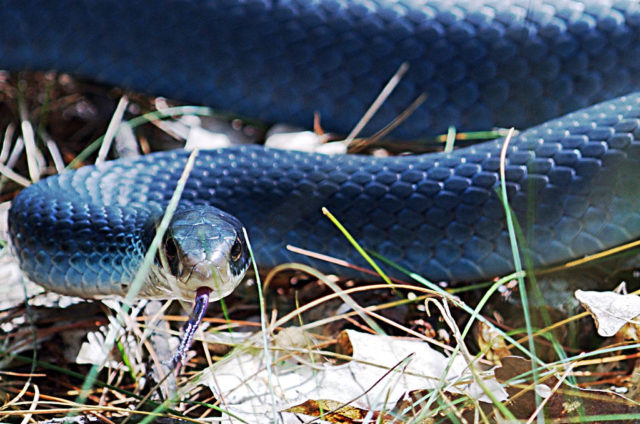
Blue Racer (Coluber constrictor foxii)
Length: 36-60 inches
Color: Black to bluish black with white chin and throat
Location in Ohio: western, central, and northern Ohio
ODNR | OPLIN | Wikipedia
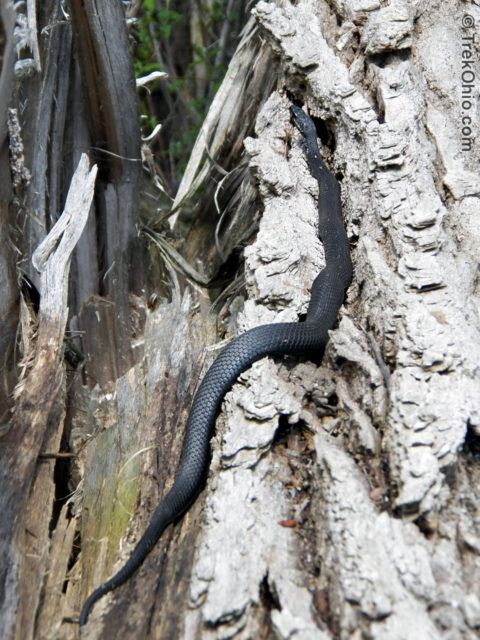
Melanistic snakes: These are black variants of snake species that normally are not black. Species that have melanistic individuals include the Northern red-bellied snake, the Eastern Hog-nosed snake, the Queensnake, and the Timber Rattlesnake. And up around Lake Erie, there is a melanistic variety of the Eastern Garter Snake like the one pictured below.
Bold Markings
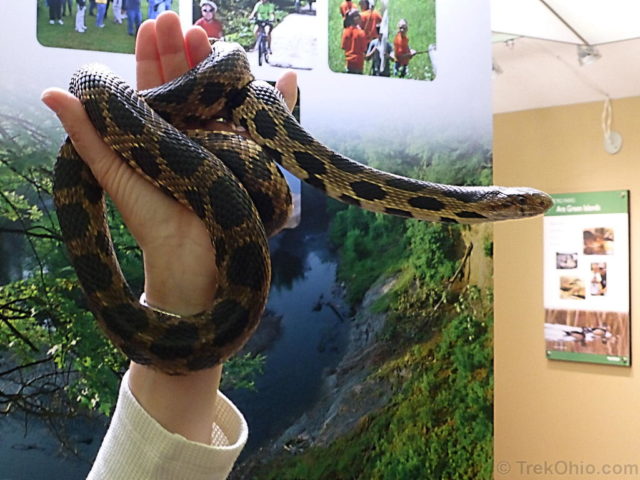
Eastern Foxsnake (Pantherophis gloydi)
Length 36-54 inches
Color: background is yellowish to light brown with dark brown to black splotches.
Location in Ohio: Western end of Lake Erie and its islands
Ohio Division of Wildlife video: Eastern Fox Snake
ODNR | OPLIN | Wikipedia
The milksnake (below) is sometimes confused with the copperhead. The copperhead has bands of color, whereas the milksnake has big, irregularly shaped spots.
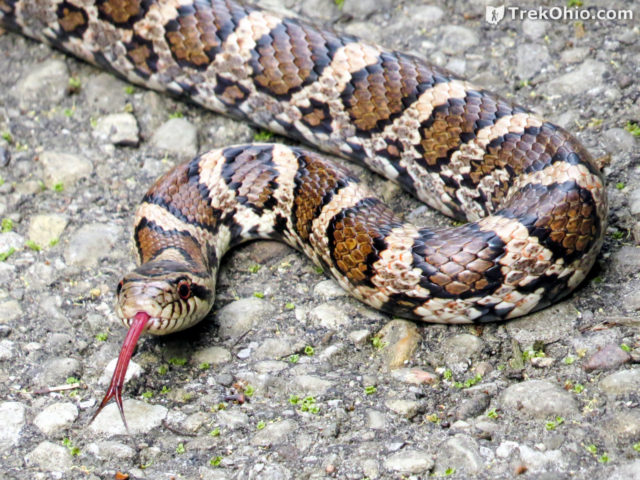
Length: 24-36 inches (60-91 cm)
Color: background is gray or tan; irregular spots are reddish-brown to brown and rimmed with black.
Location in Ohio: Widely distributed throughout state
ODNR | OPLIN | Wikipedia
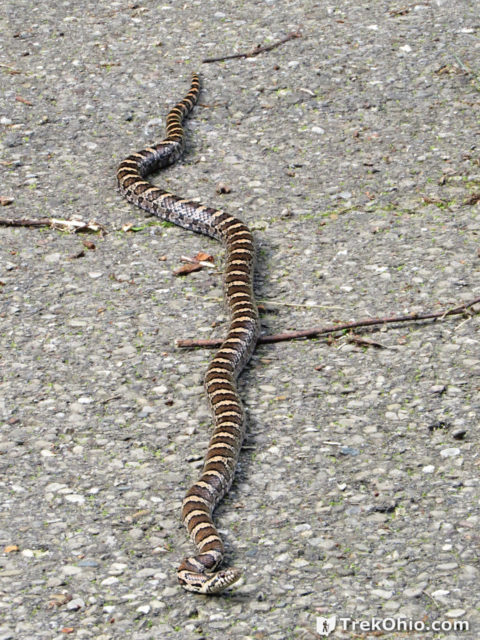
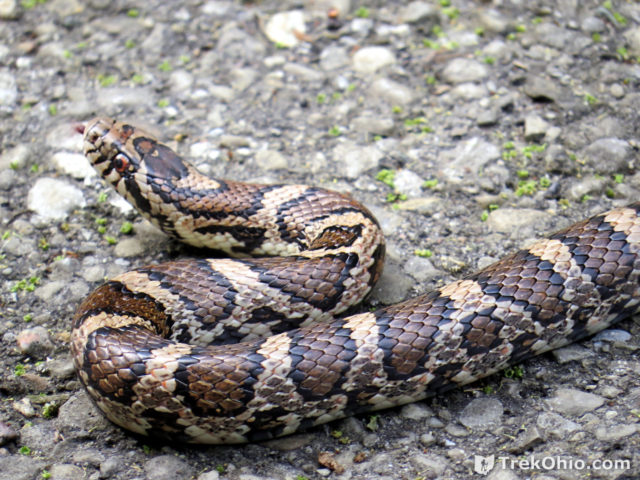
The Eastern milksnake is also distinguished by markings on its head and belly. When viewed from the top, the milksnake has a dark band between its two eyes. When the head is viewed from the side, there is a dark band starting at the eye and slanting down and back toward the belly.
The milksnake also has distinctive markings on its belly. It has nearly rectangular blotches distributed irregularly on its ventral plates. The belly rectangles kind of look like the drawing below:
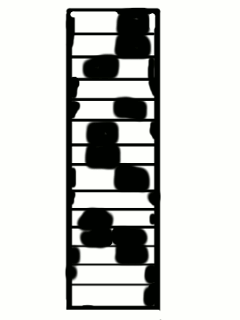
Image attribution
Whenever we included a third party's photo in this article, we have identified the photographer and the photo's license immediately above the image. I am grateful to these individuals for sharing their photos. When no photographer listed immediately above the photo, the photo is one that we've taken ourselves.
Additional reading
- ODNR: Reptiles of Ohio Field Guide (PDF)
- ODNR: Licensing and Regulations for Reptiles – what you should know if you are interested in capturing a wild animal for your terrarium.
- Buckeye Herps Blog: Ohio Snake Identification – Venomous or Not? – How to identify Ohio's venomous snakes.
- OPLIN (Ohio Public Library Information Network): What's That Snake?
- Center for North American Herpetology: A Pocket Guide to Ohio Snakes (PDF)
- Distinguishing between similar-looking species:
- GarterSnake.info: Telling Garter Snakes and Ribbon Snakes Apart – For me one of the easiest-to-note differences was that ribbon snakes have a white, vertical mark in front of their eyes, but garter snakes don't.
- iNaturalist.org: Telling Garter Snakes and Ribbon Snakes Apart
- How to Identify a Brown Snake (Storeria dekayi) – how to distinguish among Midland brownsnakes, Northern brownsnakes and juvenile ratsnakes.
- Eastern Wormsnake – How to distinguish between Eastern and Midwestern wormsnakes, as well as how to distinguish wormsnakes from other small brown snakes.
- Virginia Herpetological Society: the Eastern Ratsnake – nice series of photos showing the change in coloration as the snake matures; compared and contrasted with the Northern black racer.
- Pawnation: WHAT IS THE DIFFERENCE BETWEEN A ROUGH GREEN & SMOOTH GREEN SNAKE?
- ODNR: Nuisance Wildlife – dealing with human / wildlife conflicts (including snakes)
- A.L. Gibson: Copperhead vs Eastern Black Kingsnake! – blog post about an amazing life-and-death struggle between these two snakes. The whole struggle was documented photographically.
© Deborah Platt, Robert Platt and TrekOhio.com 2012 to 2021
Share the post "Snake Species of Ohio at a Glance"
Baby Snake With a Red Stripe on Back
Source: https://trekohio.com/2013/07/27/snake-species-of-ohio-at-a-glance/
0 Response to "Baby Snake With a Red Stripe on Back"
ارسال یک نظر